
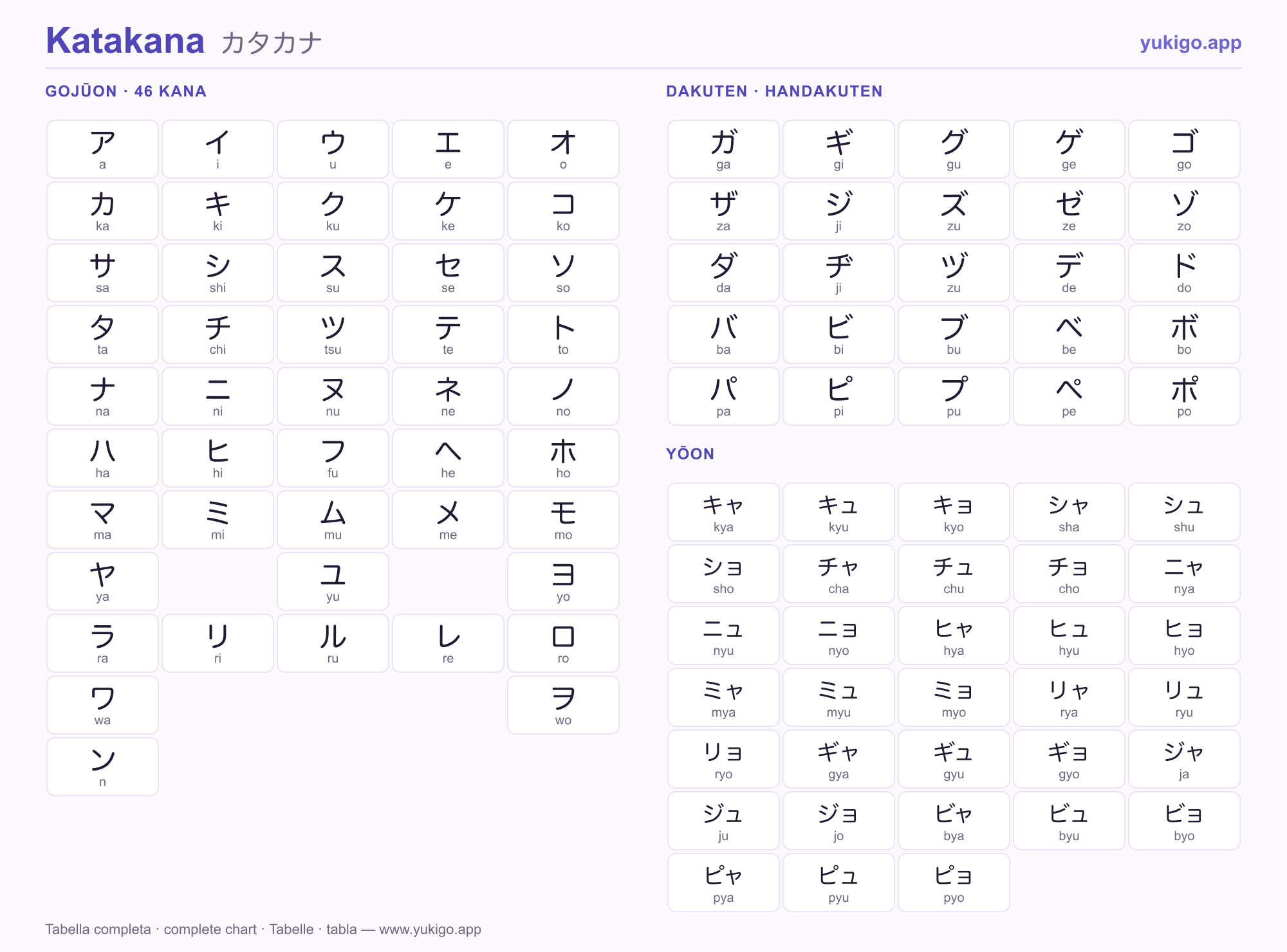
The complete katakana chart
Katakana is the second Japanese syllabary: it is used for foreign loanwords (コーヒー kōhī, “coffee”), non-Japanese proper names, onomatopoeia and emphasis.
The sounds are the same as hiragana: 46 base kana in the same grid (gojūon). Only the shapes change — sharper and more angular.
Tap any kana to hear its pronunciation and watch its stroke order, animated stroke by stroke.

Yukigo — learn katakana with audio, handwriting and spaced repetition, then kanji and grammar. Free, no ads.

Scan with your phone
The 46 base katakana (gojūon)
Dakuten and handakuten
Just like hiragana: the dakuten ( ゛) voices the consonant (カ ka → ガ ga), the handakuten ( ゜) turns the H row into P (ハ ha → パ pa).
Combinations (yōon)
An I-column kana followed by a small ャ, ュ or ョ forms a single sound: キ + ャ = キャ kya.
How to memorize katakana
If you already know hiragana you're halfway there: the sounds are identical. Focus on the lookalike pairs (シ shi / ツ tsu, ン n / ソ so) by writing them by hand. Yukigo teaches them with tracing, audio and spaced repetition, for free.
Installs in two minutes. How do I install it?
Scan the code with your phone to get the app.
Take the chart with you
The complete katakana chart as a free PDF — print it and keep it where you study.
Frequently asked questions
46 base characters, same as hiragana, plus dakuten, handakuten and combinations — the sounds are exactly the same.
They split the work: hiragana for native words and grammar, katakana for foreign loanwords, proper names, onomatopoeia and emphasis.
The chōonpu: it lengthens the previous vowel, as in コーヒー kōhī. In katakana it's the standard way to write long vowels.
Look at the stroke orientation: in シ (shi) they're more horizontal, in ツ (tsu) more vertical. Writing them in the correct stroke order fixes them better than any mnemonic.
Each kana is written in a set order, usually top to bottom and left to right. Tap any kana in the chart to watch its strokes drawn one by one.
Yes: the free PDF includes gojūon, dakuten and yōon laid out for A4 printing, with rōmaji readings.
Looking for the other syllabary? Hiragana chart →
Keep studying
- Japanese numbers →
- Colors in Japanese →
- Days of the week and months in Japanese →
- The Japanese alphabet →
Stroke order data: KanjiVG © Ulrich Apel · CC BY-SA 3.0.