
The complete hiragana chart
Hiragana is the first of the two Japanese syllabaries: it is used for native Japanese words, grammatical particles and verb endings. It's where every Japanese learner starts.
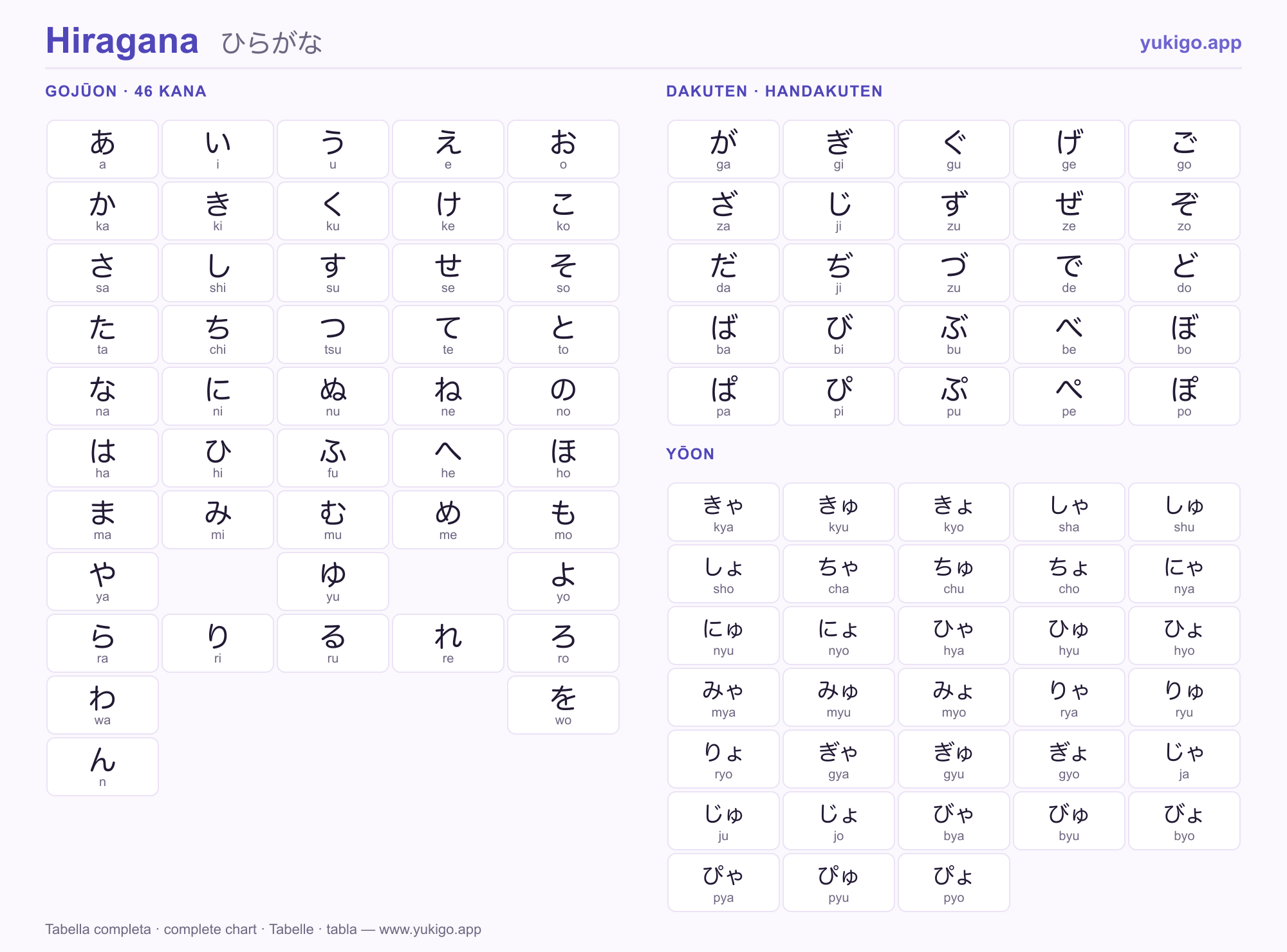
There are 46 base characters, arranged in a grid (gojūon) that crosses the five vowels with the consonants. Each cell shows the kana and its rōmaji reading.
Tap any kana to hear its pronunciation and watch its stroke order, animated stroke by stroke.

Yukigo — learn hiragana with audio, handwriting and spaced repetition, then kanji and grammar. Free, no ads.

Scan with your phone
The 46 base hiragana (gojūon)
Dakuten and handakuten
Two marks change the sound of some kana: the dakuten ( ゛) voices the consonant (か ka → が ga), the handakuten ( ゜) turns the H row into P (は ha → ぱ pa).
Combinations (yōon)
An I-column kana followed by a small ゃ, ゅ or ょ forms a single sound: き + ゃ = きゃ kya. There are 33 combinations in total.
How to memorize hiragana
Study them row by row, writing them by hand in the correct stroke order and reviewing them at growing intervals — the fastest way to make them stick. Yukigo guides you exactly like that, with finger tracing, audio and spaced repetition, free and ad-free.
Installs in two minutes. How do I install it?
Scan the code with your phone to get the app.
Take the chart with you
The complete hiragana chart as a free PDF — print it and keep it where you study.
Frequently asked questions
46 base characters; with dakuten and handakuten that becomes 71, plus 33 combinations (yōon).
Hiragana: you need them immediately for particles and word endings. Katakana come naturally right after — the structure is identical.
With 15–20 minutes a day of writing and spaced review, you can read them all within one or two weeks.
Native Japanese words, grammatical particles, verb endings and furigana (the small readings written above kanji).
Each kana is written in a set order, usually top to bottom and left to right. Tap any kana in the chart to watch its strokes drawn one by one.
Yes: the free PDF includes gojūon, dakuten and yōon laid out for A4 printing, with rōmaji readings.
Looking for the other syllabary? Katakana chart →
Keep studying
- Japanese numbers →
- Colors in Japanese →
- Days of the week and months in Japanese →
- The Japanese alphabet →
Stroke order data: KanjiVG © Ulrich Apel · CC BY-SA 3.0.